
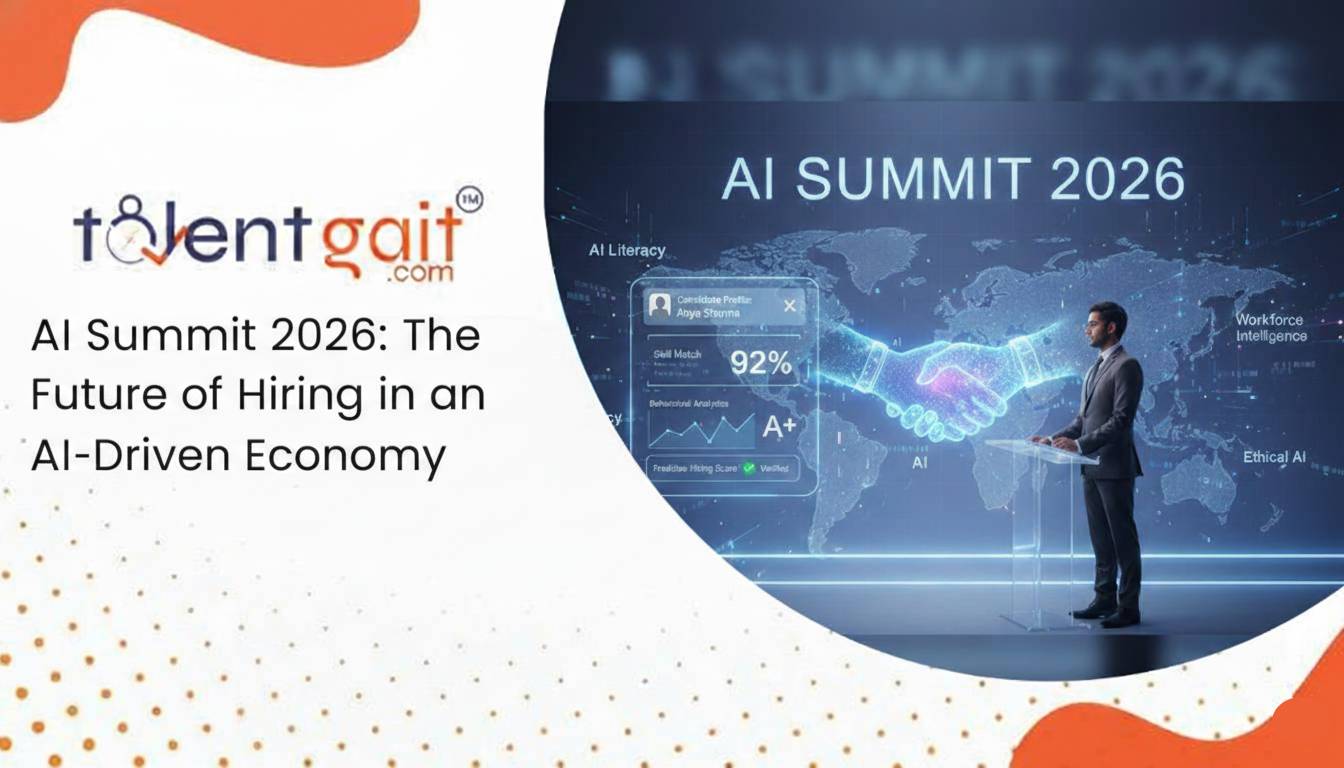
Abstract
The future of the recruitment and workforce strategy is to be found in 2026. Business leaders, policymakers, AI researchers, and talent strategists at global forums and technological conferences all known as AI Summit 2026, highlighted that the hiring systems are structurally changing. The redefinition of how organizations find, evaluate and nurture talent is happening through the use of artificial intelligence (AI), automation, predictive analytics, and generative technologies.
This paper is a research based overview of the trends in hiring in an AI-driven economy, citing quotes and efforts of major technology leaders and companies. It explores the consequences to employers, job seekers, and workforce planning systems and underscores the strategic role of AI-based recruitment systems in the transition.
1. The AI-Driven Economy: Context and Workforce Shifts
1.1 Economic Transformation Through AI
Artificial Intelligence has not just been limited to automation of routine processes, but to making decisions, predicting, coding, generating content, and optimizing enterprises. The labor market is facing: The use of AI is increasing rapidly in industries, and it includes:
- Re-designing of roles and not a complete removal of job.
- More AI competent professionals needed.
- More focus on flexibility and conceptualization.
- Monotony of cognition is automated.
- There is a changing environment in the hiring landscape.
2. Key Themes Emerging at AI Summit 2026
In spite of the fact that there are different AI summits all over the world, the theme of workforce transformation and talent strategy was a constant discussion in all of 2026 events.
2.1 Automation of White-Collar Work
In 2026, Mustafa Suleyman, who works at Microsoft, told a crowd at conferences that AI automation of office jobs is growing faster, and that AI can perform more analytical and operational jobs that were once deemed secure.
Source: Fortune (2026 timelines of AI automation).
2.2 AI-Augmented Software Development
One early warning that AI models will soon be able to do most software engineering work came in early 2026 when Dario Amodei, the CEO of Anthropic, made the claim. His statements, published by Financial Express and Business Insider highlighted the change in technical-based recruiting needs at a high rate.
Sources: Financial Express (2026); Business Insider (2026).
2.3 Productivity Through AI Infrastructure
According to Jensen Huang, the CEO of NVIDIA, AI will not replace human ability, but enhance it exponentially with investments in AI infrastructure.
(2026 industry analysis) Credit: Business Insider.
3. The Future of Hiring in an AI-Driven Economy
3.1 Shift From Degree-Based to Skill-Based Hiring
AI labor markets put the measurable skills (not credentials) first. The employers are becoming dependent on:
- Competency mapping
- Technical assessments
- Behavioral analytics
- Real-world simulations
Skill-based recruitment minimizes discrimination and enhances consistency between employer demands and the skills of the applicants.
3.2 AI-Powered Recruitment Systems
Recruitment sites of the modern times include:
- Natural Language Processing (NLP) Resume parsing.
- Predictive match of candidate.
- Screening and ranking Automated.
- Video interview sentiment analysis.
- Bias detection algorithms
The technologies can save a lot of time-to-hire and enhance quality-of-hire outcomes.
3.3 Predictive Workforce Planning
Organizations are using AI to predict:
- Skill shortages
- Attrition probabilities
- Emerging role requirements
- Training needs
Such a transformation in the recruitment strategies to the predictive type of workforce is one of the main changes in hiring that can be discussed at the AI Summit 2026.
4. Real-World Corporate Transformations
4.1 Unilever’s AI Hiring Model
Unilever has used AI-based evaluations and online interview analytics in hiring graduates.
Outcomes:
- Great decrease in time-to-hire.
- Higher diversity of the candidates.
- Better hiring integrity.
Citation: Unilever Future Leaders Programme reporting (extensively used case study).
4.2 IBM’s AI-Driven Talent Strategy
The company of IBM applies AI-based internal mobility and skills inference systems to match employees to changing project requirements.
Results:
- This is accelerated internal hiring.
- Less reliance on external recruiting.
- Better skill alignment
IBM Talent and Transformation Strategy documentation.
4.3 Salesforce and Employer Branding
Salesforce incorporates employer branding along with data-driven recruitment analytics to increase the engagement of the candidates and provide acceptance rates.
Credited Salesforce Employer Brand Strategy coverage (2026 industry reports).
5. Emerging Hiring Trends Identified in 2026
5.1 Hybrid Human-AI Decision Making
According to Dario Amodei, the same can be said of the so-called centaur model when it comes to hiring. Ranking of candidates, as well as predictive scores are generated by AI systems, whereas final decisions are confirmed by human recruiters.
5.2 Increased Focus on AI Literacy
Employers have now shifted their focus towards a candidate who can:
- Collaborate with AI systems
- Interpret AI outputs
- Maintain ethical oversight
- Develop AI enhanced workflows.
Artificial intelligence is emerging as a cross-functional competency.
5.3 Ethical AI and Bias Mitigation
In the AI Summit talks, it was consistently pointed out:
- Transparent algorithms
- Explainable AI in hiring
- Adherence to privacy regulations.
- Accountable automation management.
The hiring systems are subject to scrutiny in order to make them fair and inclusive.
6. Economic and Labor Implications
The existence of the AI-driven economy does not mean the loss of jobs but implies the reorganization of the talent. Jobs with monotonous analysis or canned productivity have more automation potential. On the other hand, jobs that need a analytical approach, innovation, systems design, and decision making are growing.
Economic models suggest:
- There can be an entry-level automation risk increase.
- Top-level technical management positions will rise.
- Owing to AI governance, there will be an increase in demand.
Such trends are forcing organizations to reconsider their talent acquisition strategies.
7. Talent Strategy Solutions in the AI Era
With the changes in the hiring process, companies need smart recruitment partners who can overcome the technological complexity.
As an AI-based recruitment and workforce intelligence tool, Talent Gait fits the AI Summit 2026 topics by:
- Applying behavioral profiling in hiring high impact.
- Sustainable placement scoring of culture.
- Incorporating shortlisting systems that are in line with DEI.
- Supporting predictive workforce planning
The recruitment systems in an AI economy should be changed to strategic talent orchestration models instead of transactional hiring models.
8. Conclusion
AI Summit 2026 brought out a radical change in the global employment ecosystem. Quotations of leaders like Dario Amodei, Jensen Huang, and Mustafa Suleyman indicate that there is an agreement that AI will significantly alter the process of recruitment and workforce design.
The future of hiring in an AI-driven economy will be characterized by:
- Data-driven and skill-based recruitment.
- Decision systems that are AI enhanced.
- Unbiased and ethical algorithms.
- Constant adjustment of the workforce.
When implemented strategically, in the context of industries that adopt AI in the recruitment process, without neglecting human control and cultural compatibility, organizations will benefit in terms of their competitive advantage in acquiring talent.
The economy of the future, which is AI-driven, is not transforming hiring as a function; it is transforming hiring as a strategic capacity needed to survive in the organization and to innovate.