
Introduction
The international recruitment environment is experiencing a significant change. Over the decades, employers used to be very dependent on traditional means of assessing candidates based on university degrees, job titles, and years of experience. But the contemporary workforce requires a more realistic strategy. With the changing nature of industries thanks to the digital transformation, automation, and artificial intelligence, companies are shifting to skill-based hiring.
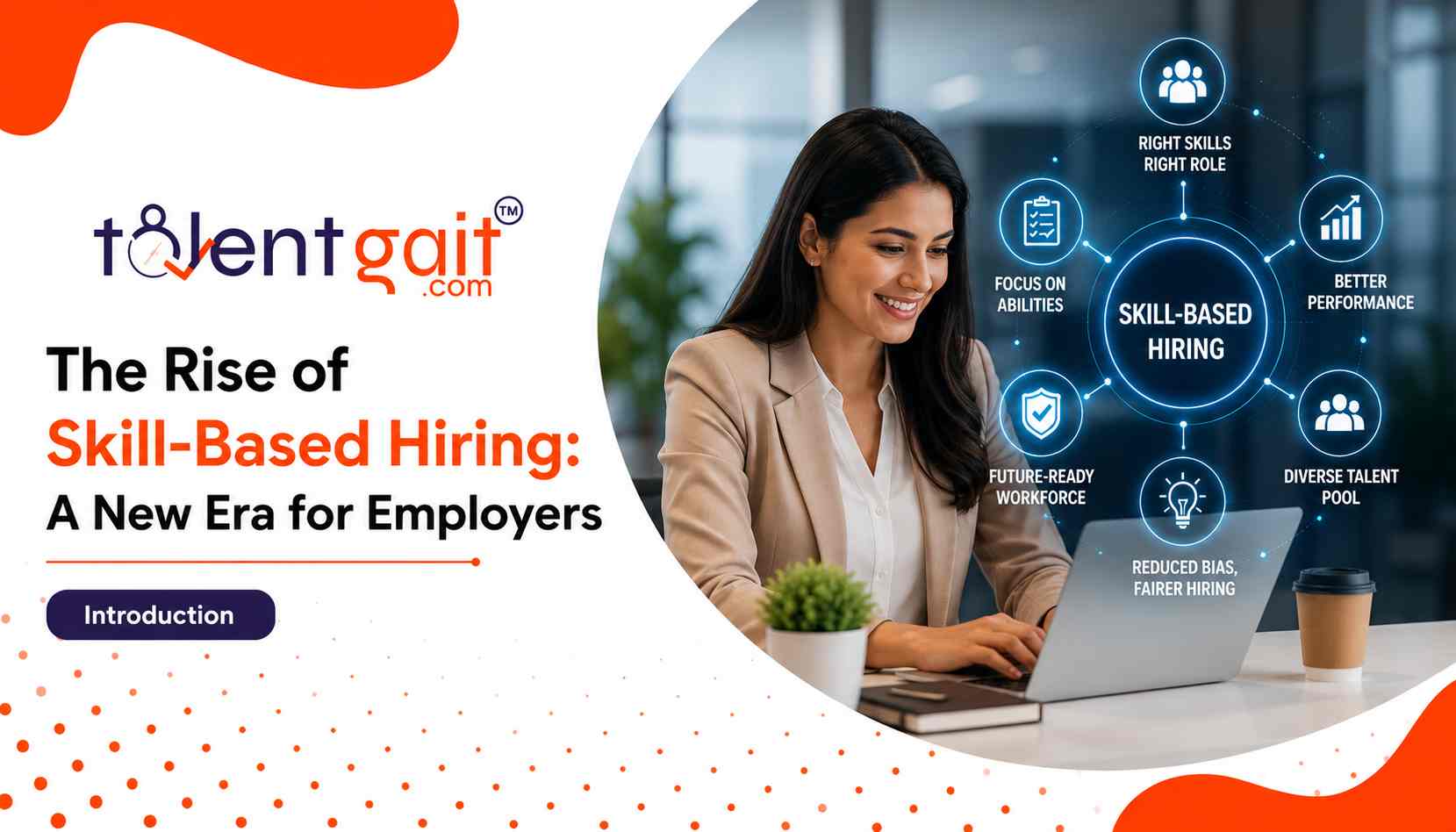
Skill-based hiring takes priority over the actual skills of a candidate and not just his or her educational background. Employers are currently looking at what a candidate is capable of performing, which includes technical skills, problem-solving skills, communication and adaptability. The change is the new era of talent acquisition, when skills and competencies have become the surest predictors of job performance.
It is also stipulated that in the LinkedIn Global Talent Trends Report 2024, where talent acquisition is based on skills, organizations tend to have better performance of their employees, higher retention, and a more diversified workforce.
What Is Skill-Based Hiring?
Skilled-based hiring- It is a method of recruitment whereby the employers focus on practical skills, competencies, and other actual abilities more than on the conventional qualifications such as degrees or job titles.
Instead of posing the questions like:
- In which location did the candidate study?
- How many years of experience?
Employers ask:
- What are the particular skills that the candidate possesses?
- Is the candidate able to do the job of the position?
- Does the candidate possess the capacity to learn and adapt quickly?
This has changed because of the fact that academic credentials are not necessarily an indicator of success in the workplace.
Why Skill-Based Hiring Is Growing
A number of aspects are causing the increase in skill-based recruitment in any industry.
1. Rapid Technological Change
Artificial intelligence, cloud computing, cybersecurity, and data analytics are examples of technologies that are changing fast. Most of the universities are not able to change their curriculum as quickly as the industry demands. Consequently, employers are now going to hire only those candidates who have the relevant technical ability.
According to the World Economic Forum Future of Jobs Report 2023, almost 44 per cent of the skills of workers will be transformed in the coming five years because of technological innovations. This compels organizations to focus on flexible skills as opposed to fixed qualifications.
2. Sealing the Global Talent Gap
There is a lack of skilled professionals in many industries. Skill-based recruitment enables employers to have a broader talent pool because it eliminates unnecessary degree requirements.
The findings of a McKinsey Global Institute workforce report (2023) indicate that those companies that lift the degree requirement grow their pool of talent, particularly in technology and digital jobs.
3. Selling Diversity and Inclusion
The traditional hiring processes usually give preference to those who attended reputable universities, which is a limiting factor to diversity, unknowingly.
Skilled hiring deals with skills and not scholarly background. This enables employers to find skilled employees that may not belong to the traditional background, such as self-educated professionals, vocational graduates and career changers.
According to the Harvard Business School report titled Hidden Workers: Untapped Talent (2021), they discovered that there are millions of talented workers who are not hired due to the inflexible degree requirements, despite having relevant skills.
Real Examples of Skill-Based Hiring
IBM’s Skills-First Hiring Strategy
The best-known case of skill-based hiring is the Skills First program of IBM.
The IBM leadership has also reiterated that a number of the jobs in the field of technology do not need four-year degrees. As an alternative, the company will assess candidates according to technical skills, credentials and practical projects.
The IBM corporate reports (2023–2025) explain that close to fifty per cent of IBM positions in the United States do not need a four-year-degree any more. The company instead relies on skill assessment and training programs to get qualified potential employees.
This solution has contributed to IBM tapping into new sources of talent as well as overcoming shortages in cybersecurity, cloud computing, and AI creation.
Google’s Career Certificates Program
Google has not been left behind in adopting skill-based hiring as it has implemented Google Career Certificates.
As per the Google workforce development reports (2022–2024), the program trains people in fields of high demand, including:
- Data analytics
- Project management
- UX design
- IT support
Most employers have now accepted these certificates as equal to the real degrees in entry-level jobs. The program illustrates the potential opportunities that skills-based recruiting can generate in alternative career paths.
Unilever’s Data-Driven Hiring Process
Unilever has also updated its recruitment system through digital testing and AI-based evaluation technologies.
The studies published in Harvard Business Review and reported by Financial Times detail how Unilever relies on online games and behavioural testing, as well as AI-based video interview analysis to assess the skills of candidates.
The outcomes of this change are:
- The employment procedure was shortened by about 75 per cent.
- Recruitment savings to the tune of millions.
- There is an increased and diverse pool of candidates.
The skills that the company targets include analytical skills, potential for leadership, and communication skills, as opposed to just academic qualifications.
The Role of AI in Skill-Based Hiring
AI is increasing the expansion of skill-based recruitment.
Recruitment systems based on the latest AI can process the profiles of thousands of candidates and compare them with the needs of the job according to the skill sets.
These systems can identify:
- Technical competencies
- Transferable skills
- Learning ability
- Cultural compatibility
Gartner HR Research 2024 provides evidence that organizations that deployed AI-driven hiring systems have accelerated the recruitment process and improved the match of candidates and job opportunities.
AI assists employers in shunning the standard methods of filtering by keywords and exploring deeper into the skill analysis.
Benefits of Skill-Based Hiring for Employers
Skill-based recruiting has a number of benefits to organizations.
Better Job Performance
Those employees who were recruited based on their real skills do not perform poorly since they have the required skills to carry out the job.
Faster Hiring Process
Digital tests and skill tests enable employers to recognize skilled job applicants within a shorter time.
Expanded Talent Pool
Laxity in educational requirements is a way of increasing the number of potential applicants.
Improved Workforce Diversity
Organizations can create more inclusive teams by hiring based on skills, as opposed to background.
Stronger Employee Retention
Workers recruited based on their ability tend to be more satisfied with their job and are able to develop their careers.
Challenges of Skill-Based Hiring
Although it has advantages, skill-based hiring is also problematic.
Measuring Skills Accurately
Employers should come up with effective evaluation procedures that can be used to test the abilities of the candidates without bias.
Organizational Mindset Change
A lot of hiring managers still use traditional credentials in assessing applicants.
Technology Implementation
The use of AI-related recruitment technologies and skill evaluation platforms is costly and involves training.
The most effective companies in terms of skill-based hiring have to combine technology and structured tests, with trained recruiters.
The Future of Skill-Based Hiring
The emergence of skill-based hiring will increase even faster within the upcoming decade.
According to the predictions in the World Economic Forum Future of Jobs Report 2023, employers will soon focus more on:
- Analytical thinking
- Creative problem solving
- Technological literacy
- Emotional intelligence
- Ability to learn continuously.
These skills cannot be easily quantified using degrees, and hence, skill-based assessment is a necessity.
With the ever-changing nature of industries, organizations with skill-based recruitment practices will be able to tap into talent pools and thus be competitive in the global labour force.
Conclusion
The hiring based on skills is a radical change in contemporary recruiting. Employers are no longer basing their decisions on educational qualifications or experience, but they are rather focusing on practical skills and proven competence to judge applicants.
This practice has already been embraced by global firms like IBM, Google, and Unilever to deal with talent shortage, enhance diversity, and develop more robust workforces.
Skill-based hiring is emerging as one of the key principles in the future of work, supported by AI-based recruitment technology and digital skills tests.
Companies that focus more on abilities rather than titles are in a better position to hire the best talent, keep up with technological change, and win in the ever-competitive job market.