
Abstract
The talent acquisition environment worldwide is gradually changing towards skills-based hiring, where organizations focus more on candidates’ real skills than some old-school indicators (like degrees or job titles). Some of the biggest strides made in this transition is the positive increase in pre-employment skills assessments.
Employers utilize these assessments to evaluate a candidate objectively, reduce the risk of hiring, and increase their workforce quality. Hence, this article will present a well-structured and research-based explanation of why companies are now satirically attracted towards skills assessment in pre pre-hiring process with relevant examples with new-age recruitment trends and forecast on what to expect while hiring by 2026.
1. Introduction: The Shift from Resumes to Real Skills
For many decades, hiring hinged on resumes, degrees and previous position titles. But they are not reliable determinants of job performance.
Groups are increasingly aware that resumes do not effectively define a candidate’s true skills, according to the LinkedIn Global Talent Trends Report 2024. That is why companies are using skills assessments to measure what candidates can actually do in real-life situations.
This change is in line with a wider trend toward skills-based hiring, which emphasizes competencies and potential performance over qualifications.
2. What Are Skills Assessments?
Skills Assessments: These are structured evaluation methods employed to assess a candidate’s skills in an area or areas relevant to particular job role(s).
These may include:
- Technical tests (coding, data analysis, etc.)
- Cognitive ability tests
- Situational judgment tests
- Communication and language assessments
- Role-specific simulations
Skills assessments provide proof of your hidden skills through direct and measurable results even when your resume provides indirect evidence.
3. Key Reasons Companies Are Adopting Skills Assessments
Improving Hiring Accuracy
A key benefit of assessments is to ensure hiring accuracy.
Often, traditional hiring techniques are poor predictors of success in a specific role while structured assessments tend to correlate with job performance (Harvard Business Review).
Employers have nothing to lose and a lot of gain from testing real skills as this minimizes the risk of hiring unsuitable candidates.
Reducing Bias in Hiring
Bias in recruitment [could] happen based on education, background, or perceptions. Skills assessments mitigate this bias by concentrating on objective performance.
Nonetheless, such assessments should never be assumed to be free from biases of their own that could exacerbate inequities in the field.
According to the Future of Jobs Report 2023 by World Economic Forum, fair and inclusive hiring becomes more vital than ever across the changing landscape of work.
Supporting Skill-Based Hiring
With the growth of industries, the need for practical skills has now been maximized.
Almost 44% of the skills that we deliver to our workers will change thanks to technology, according to the World Economic Forum. That renders conventional hiring based on formal qualifications ineffective.
This is where skills assessments come in, as they enable companies to find applicants that have the right skillset despite atypical backgrounds.
Enhancing AI-Driven Recruitment
Modern data-driven recruitment systems (AI-based) are data-centric. Decisions will better align with corporate goals. Be it employing an AI tool for adjusting worker productivity or HR tools, skills assessments offer structured data to both humans and AI tools to analyse.
Gartner HR Research 2024 notes that organizations with AI-enhanced hiring technology integrated with skills assessments improve both candidate quality and time-to-hire.
We can see that AI currently has the potential to do so much more than just filter candidates based on a resume.
Reducing Time-to-Hire
Skills assessments sift through candidates early in the hiring process, all but eliminating unqualified applicants from moving on.
Real Example: Unilever
Harvard Business Review and Financial Times reported that Unilever adopted digital assessments and AI-powered evaluation methods into their hiring process.
Results included:
- Cut recruiting time by roughly 75%
- Improved candidate quality
- Increased diversity
This shows how assessments can accelerate recruitment, while also ensuring quality.
Expanding the Talent Pool
Focusing on skills over degrees opens companies up to more candidates.
Real Example: IBM
IBM’s “Skills First” strategy (company publications 2023–2025) promotes hiring based on skills rather than academic credentials.
Such a strategy allows IBM to access talent pools that may have previously been disregarded, such as totally self-taught developers and career-changers
Aligning Candidates with Job Requirements
Skills assessments provide confidence that candidates are evaluated against the exact requirements of the position.
This reduces mismatches between what is required of the job and what an employee can deliver back at home, leading to increased performance and decreased turnover.
Organizations that hire based on skills, not job titles, report a more productive workforce (McKinsey Global Institute 2023–2024 reports).
4. Types of Skills Assessments Used by Companies
First, the assessment type depends on your company and role
Technical Assessments
If you have applied to jobs in software development, data science, or engineering.
Cognitive Assessments
Assess critical-thinking ability, logic, and learning capability
Situational Judgment Tests
Evaluate how they respond to situations in the office.
Behavioral Assessments
We assess personality traits, communication skills, cultural fit!
Work Simulations
Give candidates realistic tasks that simulate the job.
These techniques provide a holistic view of a candidate’s potential.
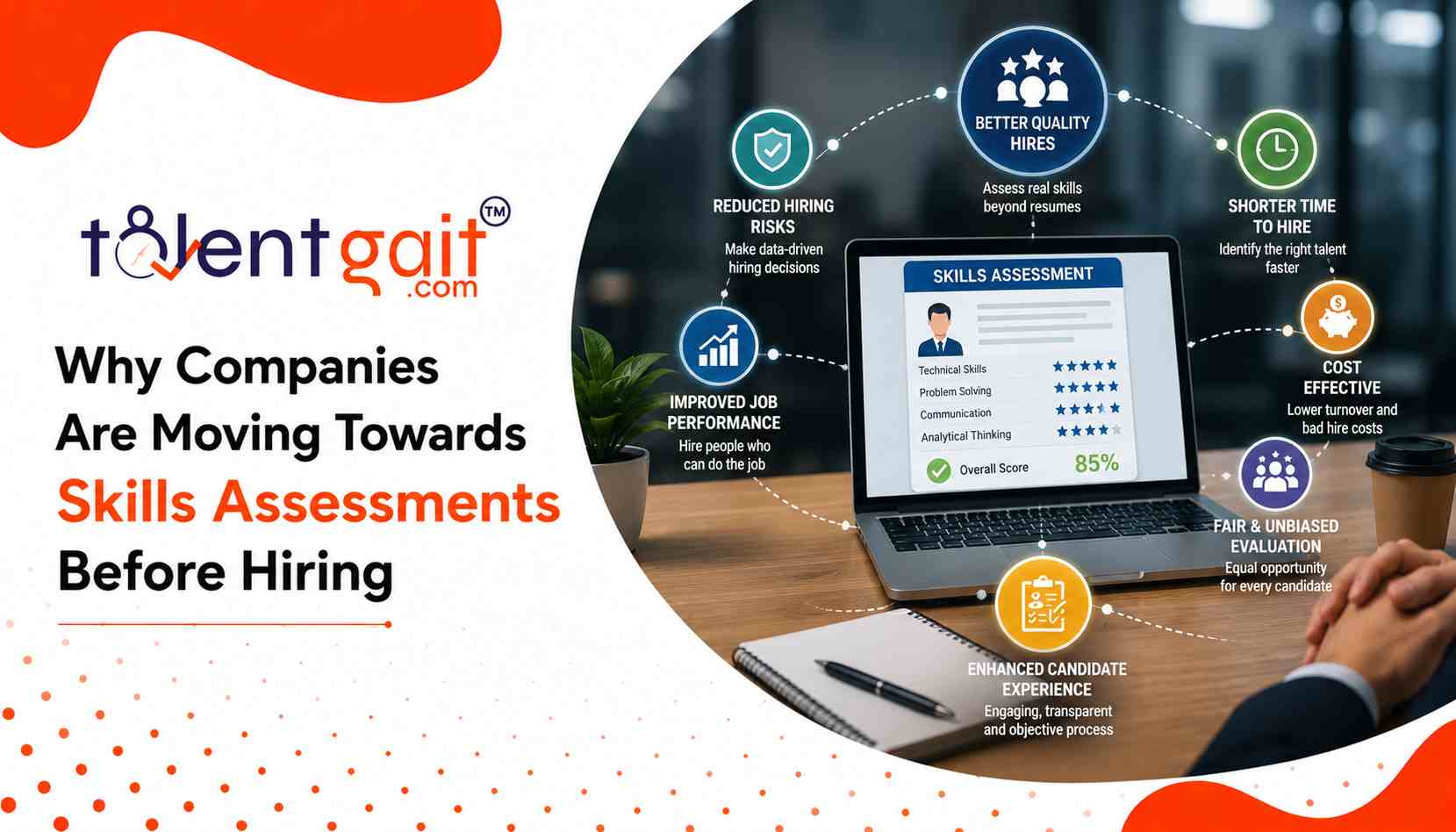
5. Benefits of Skills Assessments for Employers
Organizations conducting skills assessments gain several benefits:
- Higher quality of hires
- Reduced hiring bias
- Faster recruitment processes
- Improved employee performance
- Better retention rates
These benefits align with broader trends in hiring practices, and the future of work.
6. Challenges and Considerations
Although they offer many advantages, skills assessments bring some challenges:
Test Design and Relevance
Importance of assessments for effectively assessing job performance
Candidate Experience
Candidates may be discouraged if the assessments are too complex or take too long.
Integration with AI Systems
It is up to organizations to ensure these assessments align with AI-driven recruitment platforms.
Data Privacy and Compliance
Responsible means of handling assessment data as industrial products should also be in place, particularly under regulations such as EU AI Act (2024)
Employers must balance efficiency with fairness and transparency.
7. Future of Skills Assessments in Hiring
By 2026 and beyond, skills assessments will be standard practice in any recruitment process.
Key trends include:
- AI-powered adaptive testing
- Real-time skill evaluation
- Integration with workforce analytics
- Continuous skill tracking for employees
Organizations will value people who are open to growth and lifelong learning, which is why skill-based hiring will see a rise (LinkedIn July 2024 Global Talent Trends Report)
Conclusion
The move toward skills assessments before hiring is part of a wider transformation in recruitment. Traditional evaluation metrics such as GPA and degree credentials are increasingly becoming irrelevant for employers who prefer quantifiable capabilities that have a direct bearing on job delivery.
Its own real-world examples, shown by companies like IBM and Unilever, point out that skills assessments improve hiring accuracy, are better at bias-avoidance and enhance efficiency.
As AI continues its intrusive march through recruitment processes, skills assessments are quickly taking an affirmative role in implementing the strategies to get hiring strategy right. Organizations that embrace this model will be best placed to attract, assess, and keep high-quality talent in the future of work 2026.