
Abstract
Today, one of the most pressing problems of recruitment is how to strike a balance between the number of candidates and the quality of recruits. On the one hand, digital platforms and AI-based recruitment tools have greatly enhanced the number of applications, but on the other hand, they have not necessarily enhanced hiring results.
Employers are now faced with a challenge of how to strike a balance between large talent pool and finding talent that can genuinely fit in the job description and also the organization objective. This article is a research-based analysis of quality versus quantity in hiring, key challenges, real-life examples, and strategic solutions to these issues in the context of the trends in AI hiring, skill-based hiring, and data-driven recruitment practices.
1. Introduction: The Hiring Paradox
Recruitment technology has transformed into a technology that is easier to use than ever before in attracting candidates. Nonetheless, additional uses cannot ensure superior hires.
The LinkedIn Global Talent Trends Report 2024 indicates that one of the greatest challenges that employers face is the need to sift through volumes of applications to find the most appropriate candidates. This forms a contradiction:
- Large number of reach adds complexity.
- Quality enhances performance but must be accurate.
These two are the things that have to be balanced in order to have an effective talent acquisition strategy.
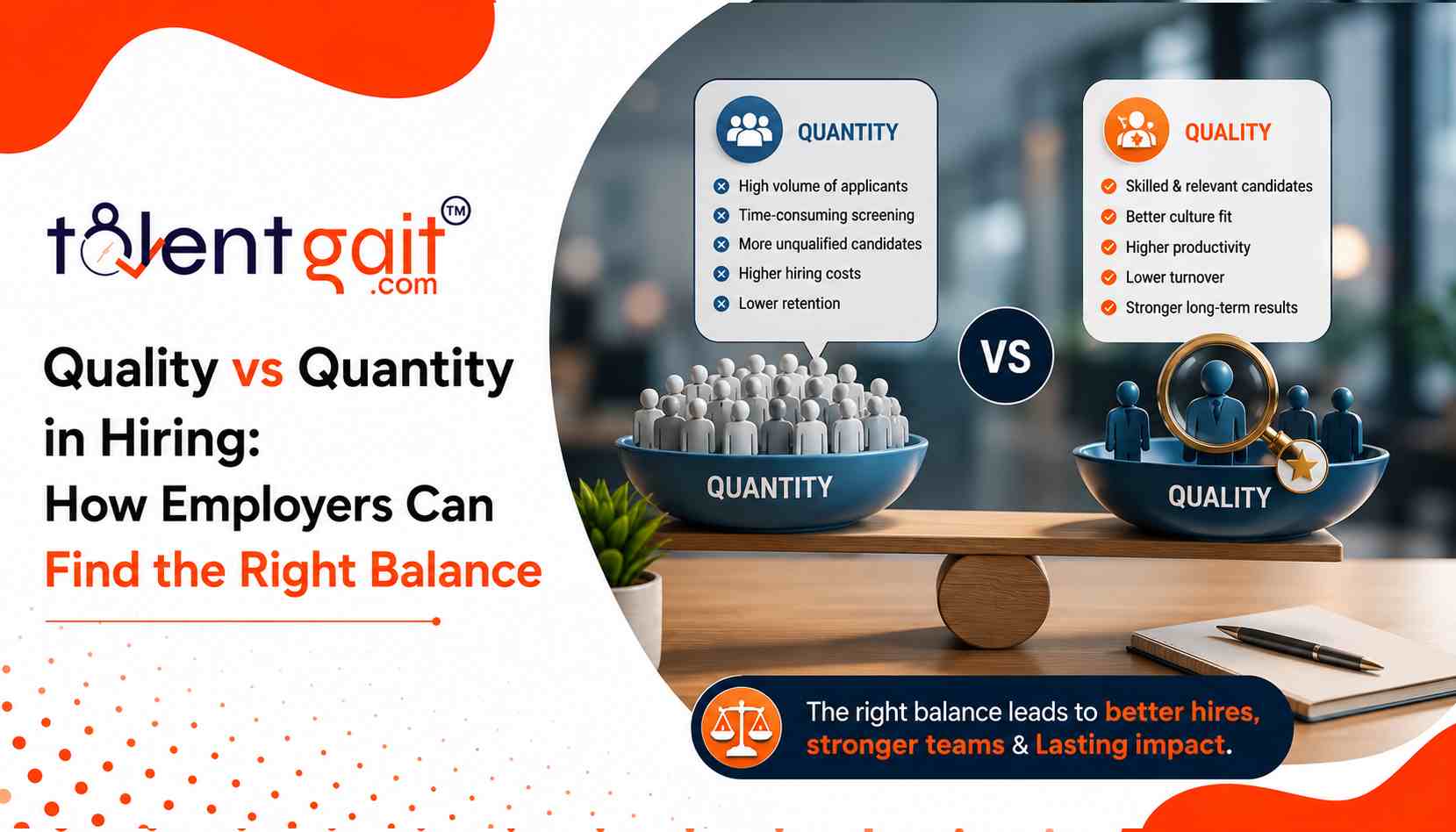
2. Understanding Quantity in Hiring
2.1 Definition
Quantity in hiring is the amount of applicants to a position or recruitment pipeline.
2.2 Advantages
- Larger talent pool
- Increased diversity of applicants
- Increased chances of rare skill discovery.
2.3 Limitations
- Increased screening time
- Higher recruitment costs
- Potential of irrelevant applications.
As online job portals have emerged, employers are likely to have many hundreds or thousands of applications to each position, many of which might not fit the criteria.
3. Understanding Quality in Hiring
3.1 Definition
Quality in hiring means the relevancy, ability, and future prospects of the candidates.
3.2 Key Indicators
- Congruence between skills and job demands.
- Cultural fit
- Performance potential
- Retention likelihood
3.3 Benefits
- Better job performance
- Reduced turnover
- Stronger organizational growth
McKinsey Global Institute (20232024) also notes that productivity and efficiency are much higher in the organization that concentrates on quality hires.
4. The Problem: Why Balance Is Difficult
4.1 Over-Application in Digital Hiring
Simple application procedures result in upsurge in applications most of whom are not appropriate.
4.2 Inefficient Screening Methods
High volumes cannot be effectively screened manually, and improperly set up AI systems can screen out good candidates.
4.3 Misaligned Job Descriptions
Poor or too general job descriptions bring in wrong applicants.
4.4 Pressure to Hire Quickly
Companies are often concerned with speed rather than quality in hiring and this results in bad hiring.
5. Role of AI in Managing Quality and Quantity
AI is essential in equalizing the result of hiring because it allows recruiters to use data to achieve this end.
Key Capabilities
The best candidates have a short shelf life. Loss of quality talent occurs because of a slow hiring process.
- Automated resume screening
- Predictive candidate matching
- Skill-based filtering
- Candidate ranking systems
Gartner HR Research 2024 states that recruitment built on AI enhances efficiency and accuracy, when implemented appropriately.
Nevertheless, the application of AI should be cautious to prevent excessive filtering or bias.
Results:
- Saved about 75% of the time hiring.
- Improved candidate quality
- Increased diversity
The approach adopted by Unilever shows us that structured screening can be used to handle the high application volumes.
IBM: Skill-Based Filtering
The Skills First approach to hiring by IBM (company publications 2023–2025) emphasizes the evaluation of potential employees in terms of competencies and not degrees.
This will minimize the number of irrelevant applications and enhance the shortlisted candidates.
LinkedIn Data Insights
LinkedIn Talent Solutions indicates that organizations that hire based on data are more capable of hiring quality applicants despite the high number of applicants.
7. Strategies to Balance Quality and Quantity
7.1 Define Clear Job Requirements
Have the necessary and optional skills well defined to get the right candidates.
7.2 Use Skill-Based Assessments
Look at the applicants by their real skills and not resume.
7.3 Implement AI-Driven Screening
Filter applications effectively using AI and retain accuracy.
7.4 Optimize Job Descriptions
Use no ambiguous language and expectations.
7.5 Limit Application Channels
Placing advertisements on excessive sites may lead to unnecessary applications.
7.6 Use Predictive Hiring Models
Examine past records to determine trends on successful employment.
McKinsey attributes that predictive hiring enhances better workforce outcomes and minimizes hiring mistakes.
8. Benefits of Achieving the Right Balance
Organizations that are able to strike a balance between quality and quantity enjoy:
- Faster hiring cycles
- Better candidate-job alignment
- Reduced recruitment costs
- Improved employee retention
- Stronger employer brand
These results are consistent with the current AI hiring trends and future of hiring strategies.
9. Challenges and Considerations
Over-Automation
Overuse of AI can result in the loss of great candidates.
Bias in Algorithms
Regular audits of AI systems are needed.
Data Quality Issues
leads to inaccurate evaluations of all candidates due to flawed data.
Regulatory Compliance
Employers are obligated to meet legal requirements (such as the EU AI Act, which will enter into force in 2024) that foster transparency and accountability.
10. Future Outlook
The quality/quantity balance will be in a continuous state of development as AI and analytics progress.
Key trends include:
- Real-time candidate evaluation
- AI-powered skill mapping
- Personalized hiring journeys
- Connection to workforce planning systems.
Conclusion
Quality versus quantity in recruitment is a characteristic challenge in the contemporary recruiting. Though this brings about more opportunities by attracting a lot of applicants, it also brings with it complexity. The alternative to this is that concentrating on quality, without adequate reach, can restrict the access to talent.
This can be resolved by implementing a balanced, data-driven solution that incorporates AI-driven hiring, skill-based hiring, and predictive analytics. This balance can be attained with the appropriate strategy as real life experiences of organizations like Unilever and IBM show.
A competitive edge in talent acquisition will be huge in the future of work 2026, and organizations that are able to balance both quality and quantity will be ahead of others.