
Recruitment Analytics Services That Improve Hiring Performance
Your hiring dashboard shows open roles, added candidates, and filled positions, and on the surface it all looks like progress, but most teams still cannot answer the one question that truly matters: are we getting better at hiring? Many organisations track activity, confuse motion with momentum, and repeat the same costly hiring mistakes quarter after quarter. The real change comes when you stop counting actions and start reading data. Great hiring runs on clear evidence, and Talent Gait gives you exactly that by turning scattered recruitment numbers into decisions you can defend, repeat, and improve over time.

The Numbers Your Dashboard Is Hiding From You
Time-to-fill feels like a useful number because it is simple to read, but it rarely tells you where your process is breaking or what is costing you your best candidates. The metrics that actually move offers, drive retention, and build hiring confidence tend to sit deeper in your data, and most standard reports skip right past them without a second glance.
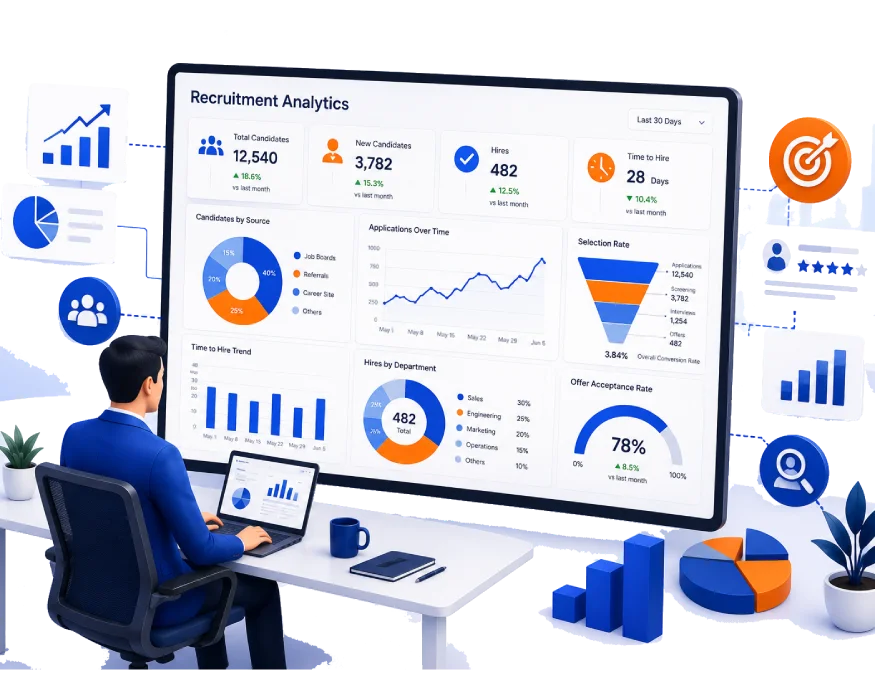
Talent Gait goes further than surface-level counts and focuses on the signals that shape real hiring outcomes across your entire talent pipeline:
When you track the right set of metrics with discipline and consistency, the fog around your hiring process lifts quickly and clearly.
- Time-to-feedback — the gap between when an interview ends and when a decision reaches the candidate, because slow feedback quietly pushes your strongest prospects toward competing offers.
- Offer acceptance rate — a low rate rarely means your pay is off, and it usually points to a candidate experience that feels disorganised or disrespectful of people’s time.
- Quality of hire by source — referred hires tend to stay twice as long as job-board applicants, and your budget should follow that truth rather than habit.
- Interviewer consistency — when scores swing widely between different interviewers for comparable candidates, your hiring decisions start to resemble a coin toss rather than a considered choice.
- Diversity flow by stage — tracking representation only at the applicant level hides where your pipeline actually loses diverse candidates, which is almost always further down the funnel.
Where Hiring Decisions Actually Break Down
When leaders are asked where their hiring slows down, most point to sourcing and say there are not enough good applicants coming through, but the data tells a very different story in the vast majority of cases. The real bottleneck usually sits later in the funnel, long after a strong candidate has cleared your first rounds of review.
A candidate finishes a solid interview and then waits more than a week for any response, and in that time they accept a competing offer from an employer who moved faster and communicated better. That single delay then cascades into a longer hiring cycle, more ghosting, and a vacancy that costs your business far more than the original delay ever seemed to justify.
Misaligned sourcing channels drain budget in a quieter but equally damaging way, because many teams keep paying for job boards that deliver volume without delivering keepers, while a referral channel that outperforms everything else four to one goes without proper investment. Nobody spots that imbalance without proper segmentation and channel-level data.
Calibration failures add another layer of damage when one interviewer scores generously and another cuts scores aggressively, making your hiring bar inconsistent and your decisions harder to defend. Talent Gait brings each of these fractures into full view with hard numbers, so you can fix the actual cause rather than keep adjusting things that were never the problem.
How Talent Gait Turns Raw Data Into Hiring Confidence
We built our recruitment analytics service around one clear principle: your recruiters should spend their time acting on insight, not building spreadsheets, and every feature we offer connects directly back to a hiring outcome you can measure and improve.
Here is what working with Talent Gait gives your team:
- Real-time dashboards that flag drop-offs and delays as they happen so your team can step in before a strong candidate disengages from the process.
- Predictive analytics that use your own historical hiring data to forecast which candidates are most likely to succeed and stay beyond their first year.
- Seamless ATS integration that pulls your existing data into one clean and reliable view without requiring manual exports or time-consuming reconciliation work.
- Cost-per-hire trend analysis that monitors direction over time and catches gradual budget creep before it becomes a significant financial problem.
- Workforce planning insights that map your future headcount requirements against your live talent pipeline so you always have a clear view of what is coming.
Our team pairs every part of the platform with hands-on human guidance, because we know a tool alone is not enough. Talent Gait helps you read the signals properly, set meaningful benchmarks, and adjust your hiring strategy as market conditions change around you.
Ethics, Privacy, and Data You Can Trust
Candidate data carries genuine responsibility, and Talent Gait takes that seriously at every stage of the process. We operate in full alignment with GDPR, so every record is handled lawfully from the moment it is collected right through to the moment it is deleted.
We practise data minimisation as a standard part of how we work, gathering only what the hiring process genuinely requires and leaving nothing extra sitting around as a liability or a risk. Transparency runs through every interaction too, because candidates who understand how their information is used are far more likely to trust your brand and speak positively about their experience, even when they do not receive an offer.
Frequently Asked Questions
Start with time-to-feedback, offer acceptance rate, and quality of hire by source, because these three metrics together reveal whether your pipeline runs efficiently, converts candidates effectively, and produces hires who actually stay and perform well over time.
Recruitment analytics exposes which sourcing channels deliver retained talent and which ones drain budget without results, while also automating repetitive screening tasks and directing recruiter time toward the late-funnel conversations that actually close strong candidates at a lower overall cost.
Small businesses have less margin for hiring waste, which makes each hire far more consequential, and tracking a focused set of metrics carefully is far more valuable than loosely monitoring a long list of numbers that nobody has time to act on.
Combine six- and twelve-month retention rates with hiring-manager performance ratings taken at around ninety days, and then segment those figures by sourcing channel and interviewer to pinpoint exactly where your strongest and longest-staying employees consistently come from.
Pipeline metrics work best when reviewed weekly, decision-quality metrics benefit from monthly review, and post-hire outcome data should be assessed quarterly so that short-term noise does not distort your reading of longer-term hiring trends.
Stop Guessing. Start Hiring Smarter with Talent Gait.
Your strongest candidates will not wait around for a process that feels slow, inconsistent, or unclear, and Talent Gait gives you the real-time clarity to move fast, hire well, and demonstrate the value of every decision your team makes. Book a demo today and find out what your data has been trying to show you all along.