
Abstract
The emerging technology is transforming the manner in which we labor. This rapid change is driven by the artificial intelligence (AI) and automation. The companies need to assist their teams in learning and developing to remain strong. This change has two key concepts behind it, upskilling and reskilling.
The two approaches assist employees in developing new skills. Nevertheless, they vary in the scope in general and the long-term objectives they pursue. This article goes into a lot of detail on upskilling vs reskilling. We provide obvious facts and real-life examples to inform your decision. New ideas about the future of work 2026, AI and HR, and skill-based hiring will also be found. Keep reading to discover how to put the most effective training plans together to suit your evolving team.
1. Introduction: Workforce Transformation in the AI Era
Work is becoming dynamic. Monotonous jobs are being automated and new jobs are being created in fields like data science, cybersecurity, cloud computing, and AI engineering.
The World Economic Forum Future of Jobs Report 2023 has estimated that about 44 percent of skills of workers will change in five years; thus, continuous learning is not an option, but a necessity.
Companies need to choose between improving the current skills (upskilling) or training staff to completely new positions (reskilling). The productivity, innovation, and long-term business sustainability directly depend on the effectiveness of this decision.
2. Defining Upskilling and Reskilling
2.1 Upskilling
Upskilling is the process of expanding the current skill base of an employee to help him or her perform better in his or her present position or to equip him/her with higher duties in the same field.
Characteristics
- Concentrates on skill development.
- Develops on prior knowledge.
- Supports career progression
- Conforms to gradual technological change.
Examples
- Educating a software engineer on advanced AI systems.
- Educating a professional in finance on data analytics.
- Training leadership skills in mid-level managers.
Upskilling makes employees relevant as the job roles are transformed.
2.2 Reskilling
Reskilling is a process that involves training employees to carry out completely new functions, usually due to job displacement or re-structuring.
3. Skill-Based Hiring as a Core Strategy
Characteristics/strong>
- Concentrates on role change.
- Enables career shifts
- Addresses job obsolescence
- Congruent with disruptive technology change.
Examples
Preparation of the administrative personnel to work in digital operations.
Re-positioning manufacturing personnel to maintenance positions in robots.
Allowing customer service to be transferred to data support positions.
When the current jobs become obsolete, reskilling is necessary.
| Aspect | Upskilling | Reskilling |
|---|---|---|
| Objective | Improve current role performance | Transition to a new role |
| Scope | Incremental learning | Transformational learning |
| Risk Level | Low | Moderate to high |
| Time Investment | Short to medium term | Medium to long term |
| Business Impact | Enhances productivity | Enables workforce redeployment |
To develop effective talent development strategies, it is important to understand these differences.
4. Why Upskilling Is Critical in 2026
4.1 Keeping Pace with Technological Change
AI and automation are changing the way we work. Because of this, workers must update their skills often to stay on track. The LinkedIn Global Talent Trends Report 2024 shares a clear fact. It shows that when companies pay for team learning, workers stay longer and care more about their jobs.
4.2 Improving Employee Retention
Training shows your team that you care about their growth. When people feel valued, they are much happier at work. This means they are less likely to leave for another job.
4.3 Enhancing Productivity
Workers with fresh skills get more done in less time. They also bring great new ideas to the table and help the business grow.
Real Example: Amazon
Amazon shows how well this works. The company spent over 1 billion dollars on new training plans. They teach their staff how to use cloud computing and machine learning. This huge step helps their team work better and smarter.
This project contributed to enhancing internal mobility and labour productivity.
5. Why Reskilling Is Equally Important
5.1 Addressing Job Displacement
Due to automation, some job functions will be eliminated, and reskilling will become necessary to ensure the continuity of the workforce.
The International Monetary Fund World Economic Outlook 2024 has shown that AI may affect almost 40 percent of the world workforce, which explains the necessity of the workforce adaptation.
5.2 Filling Emerging Skill Gaps
Reskilling helps an organization to hire internally rather than depending on external recruitment to fill new positions.
5.3 Cost Efficiency
Recruiting new talent can be costly. It is also much cheaper and quicker to reskill current employees.
Real Example: IBM
IBM workforce transformation programs (company publications 2023–2025) focus on reskilling employees to work in new jobs in AI, cloud computing, and cybersecurity.
This will enable IBM to embrace technological change and institutional knowledge is maintained.
6. Role of AI in Upskilling and Reskilling
AI is changing the manner in which organizations are deploying workforce development strategies.
Key Applications
- Personalized learning pathways
- Skill gap analysis
- Predictive workforce planning
- Adaptive training programs
Gartner HR Research 2024 indicates that AI-based learning tools enhance the effectiveness of training and the experience of employees.
Through AI, organizations can shift their reactive training to proactive workforce planning.
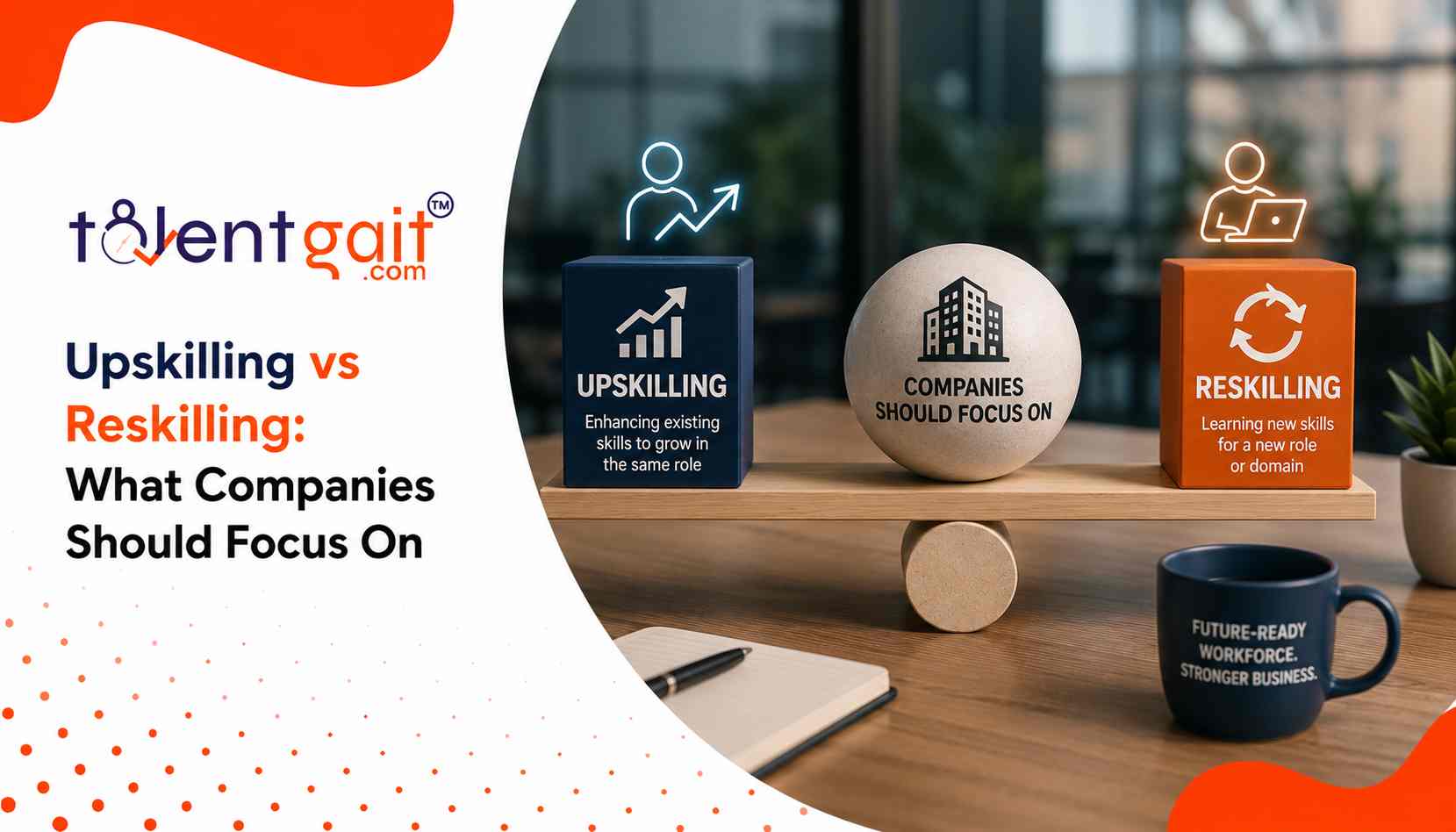
7. Upskilling vs Reskilling: What Should Companies Focus On?
The decision between upskilling and reskilling is subject to business.
When to Focus on Upskilling
- Roles are not going away, they are changing.
- The use of technology is gradual.
- The employees require advanced capabilities.
When to Focus on Reskilling
- Positions are becoming a thing of the past.
- Different skills are needed in new business models.
- The restructuring of workforce is needed.
Balanced Approach
The hybrid strategy of combining the two approaches is beneficial to most organizations.
As McKinsey Global Institute (2023–2024 reports) indicate, companies investing in upskilling and reskilling are more resilient and able to respond to changes in the market.
8. Integration with Skill-Based Hiring
Skill-based hiring strategies are closely related to upskilling and reskilling.
Organizations increasingly:
- Recruit on skills and not degrees.
- Create internal talent pipelines.
- Continuous learning helps to keep up with the competition.
This fosters a single ecosystem of learning, staffing, and human resource development.
9. Challenges in Implementation
Organizations play a crucial role but have to deal with a number of challenges:
Resource Constraints
Training programs need investment in time, tools and infrastructure.
Resistance to Change
The workers might be reluctant to embrace new roles or technologies.
Measurement of Outcomes
It may be complicated to evaluate the effectiveness of training programs.
Alignment with Business Strategy
Educational programs should be in line with organizational objectives in order to provide value.
10. Future Trends in Workforce Development
The workforce strategies will be centered on:
- Continuous learning models
- AI-driven skill mapping
- Internal talent mobility
- Real-time performance tracking
The report Future of Jobs by the World Economic Forum (2023) states that skills like critical thinking, creativity, and adaptability will gain importance.
Companies investing in learning ecosystems will obtain a competitive edge in the future of work.
Conclusion
Upskilling and reskilling are no longer those extra-curricular activities – they are the inseparable parts of the contemporary workforce management. Whereas upskilling is about improving skills and abilities of the already available employees, reskilling is whereby organizations are able to respond to structural changes within the job market.
The effectiveness of investing in employee development can be proven with real-life examples of companies like Amazon and IBM. With the help of AI-based learning tools and data-driven knowledge, organizations will be able to develop flexible, future-proof workforces.