
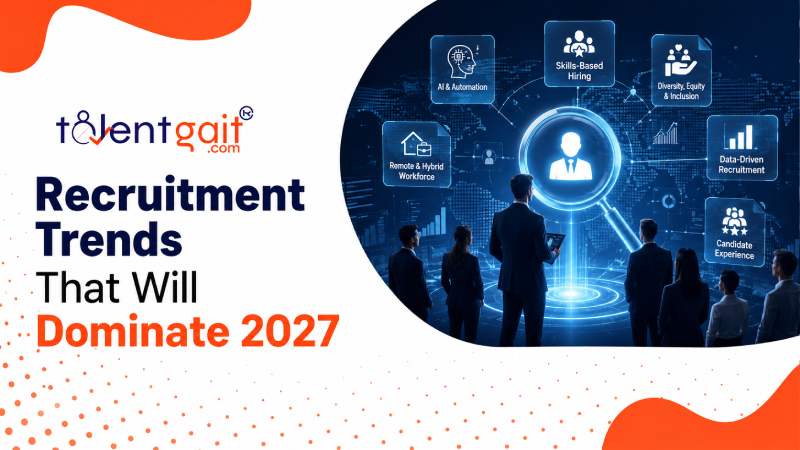
Hiring is changing fast. Skill gaps are growing wider every year. Degree requirements are slowly fading away. Candidates now judge companies before they get any offer. These shifts are not future predictions. They are already visible in 2026 hiring data. If you lead a team or manage talent, pay close attention. What worked two years ago will not work in 2027.
The Old Hiring Playbook Is Failing
Posting a job and waiting simply does not work. In 2026, employers had 6.9 million open jobs. Only 4.8 million positions were filled each month. That gap is large and not closing. The problem is not the number of applicants. The problem is that candidates do not have the right skills. Around 50% of hiring managers say this clearly. Another 26% admit they cannot assess self-taught skills. In 2027, recruiters must filter for real capability. Credentials alone will not tell you enough anymore.
What 2026 Numbers Say About 2027
The data from 2026 points in one direction. AI use in recruiting jumped from 26% to 51% in twelve months. Skills-based hiring now covers 85% of employers. Internal candidates fill 14% of open roles at lower cost. These are not small experiments anymore. They are becoming standard practice. Any hiring plan built for 2027 must include all three.
Candidate Experience Is Now a Real Differentiator
Candidates watch how you treat them closely. They notice slow replies and vague communication. They share bad experiences publicly with others. That hurts your employer brand directly.
- Bad hiring experiences are shared quickly on review sites and social media.
- As slow processes move good candidates to faster moving companies.
- A personalised outreach can increase reply rates up to 46%.
- Structured interviews cut the drop-off rate in the hiring process.
- Share clear role details early on to reduce last minute withdraws.
How you treat candidates during hiring reflects your company’s true values to everyone watching.
6 Hiring Shifts That Will Shape 2027
Six ways companies treat job seekers during the recruitment process conveys their true values to all outside observers.
- Skills Replace Degrees as the First Filter – Degree requirements are dropping fast — across industries. In 2025, 53% of employers removed degree filters. That was nearly double the number from the year before. By 2027 skills assessments will be the standard first step. Work samples and practical tasks will replace the traditional CV review.
- AI Handles the Time-Heavy Parts of Recruiting – AI is not taking recruiter jobs away. It is taking repetitive tasks off their plates. Sourcing, scheduling, and outreach now run faster with AI tools. Recruiters using AI report saving close to one full day per week. That saved time goes into better hiring decisions instead.
- Internal Mobility Becomes a Real Priority – Most companies still overlook internal candidates at hiring time. Right now, only 6% of recruiting budgets go to internal searches. Yet internal hires fill 14% of open roles. That return is too good to ignore any longer. In 2027, smart companies will build internal talent pools first.
- Employer Brand Must Speak to Growth and Learning – Generic company values no longer attract strong candidates. Early-career talent wants to know something specific. They want to know if the company will help them grow with AI. Employer branding in 2027 must show real career paths. It must show what daily work with technology looks like.
- Assessing Self-Taught Skills Needs a Clear Process – It can be difficult for recruiters to quantify experience not gained from formal education. There needs to be a systematic answer by 2027. There needs to be a structured answer by 2027. Skills portfolios and practical peer reviews are filling this gap. The companies that figure this out first will hire better talent.
- Quality of Hire Becomes the Core Metric – Only 20% of companies measure quality of hire well today. That number needs to grow significantly by 2027. Strong TA teams will track six-month retention and performance ratings. They will also track hiring manager satisfaction scores closely. These metrics will decide which sourcing channels get more investment going forward.
Conclusion
Recruitment in 2027 rewards precision over volume. Skills-based filters, AI tools, and strong candidate care are not optional extras. They are the foundation of competitive hiring. Companies making these changes now will move faster and convert better next year. Pick the one area your current process handles the worst and start fixing it today.